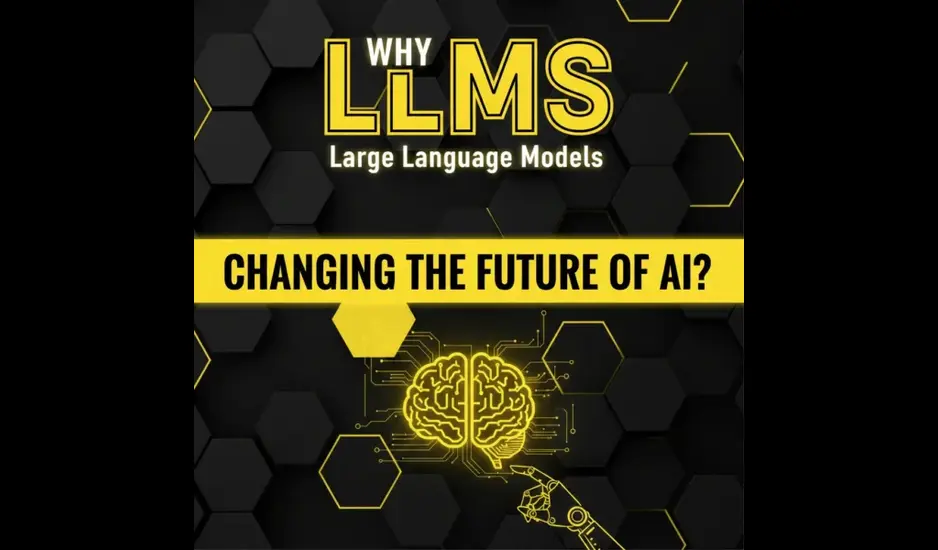
Large Language Models, often called LLMs, are advanced AI systems designed to understand and generate human language. They are trained on huge amounts of text data so they can read, write, and respond in a natural way. At the core of these models is a technology called the transformer, which helps the system understand how words relate to each other in a sentence.
Transformers use two main parts: an encoder and a decoder. The encoder reads and understands the input text, while the decoder creates meaningful responses based on that understanding. A key feature of transformers is self-attention, which allows the model to focus on the most important words in a sentence and understand context more accurately.
Unlike older AI models that processed words one by one, transformers can process entire sentences at the same time. This makes training much faster and more efficient, especially when using powerful hardware like GPUs. Because of this design, LLMs can be extremely large, sometimes containing hundreds of billions of parameters and learning from massive sources such as websites, books, and encyclopedias like Wikipedia.
Why LLMs Are Changing the Future of AI

Large Language Models are important because they are highly flexible. A single model can answer questions, summarize long documents, translate languages, write content, and even hold conversations. This versatility is changing how people interact with technology, search engines, and virtual assistants.
Although they are not perfect, LLMs are very good at predicting and generating text based on a small amount of input. This makes them a key part of generative AI, where machines create content that feels human-like. Their size allows them to recognize complex patterns in language and apply that knowledge across many tasks.
Some well-known examples include GPT-3, which has 175 billion parameters, and ChatGPT, which can generate clear and natural responses. Other models like Claude, Jurassic-1, Cohere Command, and LightOn’s Paradigm also offer strong language capabilities, support multiple languages, and provide APIs that developers can use to build AI-powered applications.
How Do Large Language Models Work?
To understand how LLMs work, it helps to look at how they represent words. Early AI systems treated each word as a simple number, which made it difficult to understand the meaning or the relationships between words. Modern LLMs solve this problem using word embeddings, which represent words as vectors in a multi-dimensional space.
With word embeddings, words that have similar meanings are placed close to each other. This allows the model to understand context, grammar, and relationships between words. The encoder converts text into these numerical representations, and the decoder uses them to generate meaningful responses, such as sentences, summaries, or answers.
Applications of Large Language Models
Large Language Models are used in many real-world applications. They can write marketing content, product descriptions, and articles with a natural tone. In knowledge-based systems, LLMs can answer questions using information from large document collections or digital archives.
They are also widely used for text classification, such as analyzing customer sentiment, grouping similar documents, and improving search results. In software development, LLMs can generate code from simple text instructions, helping developers write programs, create database queries, and design websites faster.
Text generation is another major use case. LLMs can complete sentences, draft documentation, and even create stories, making them useful in education, entertainment, and business communication.
Real-World Uses of Large Language Models
LLMs are trained using very large neural networks with many layers and connections. Each connection has values called parameters, which the model adjusts during training. These parameters allow the model to learn language patterns and predict the next word in a sentence based on previous words.
Training requires huge amounts of high-quality data. The model learns through a process called self-learning, where it repeatedly tries to predict the next token and improves itself when it makes mistakes. Once training is complete, the model can be adapted for specific tasks through a process known as fine-tuning.
There are different learning approaches used with LLMs. In zero-shot learning, the model responds to requests without extra training. Few-shot learning improves results by providing a small number of examples. Fine-tuning goes a step further by training the model with task-specific data to achieve better accuracy.
The Future of Large Language Models
The success of models like ChatGPT, Claude, and Llama shows that LLMs are moving closer to human-like understanding and communication. While current models still make mistakes, future versions are expected to be more accurate, less biased, and more reliable.
Developers are also exploring training LLMs with audio and video, not just text. This could open new possibilities in areas like autonomous vehicles and robotics. In the workplace, LLMs are likely to reduce repetitive tasks, support customer service, and assist with routine writing and data handling.
Conversational AI will continue to improve as well. Virtual assistants will become better at understanding user intent and responding to complex requests, making interactions more natural and helpful.
How AWS Supports LLMs Development
AWS provides powerful tools to help developers build and scale applications using LLMs. Amazon Bedrock offers a simple way to access and use LLMs from Amazon and leading AI companies through a single API. This allows developers to choose the best model for their specific needs without managing complex infrastructure.
Amazon SageMaker JumpStart is another useful service that offers ready-to-use machine learning models and solutions. It allows users to quickly deploy, customize, and scale pretrained models for tasks like text summarization and content generation. With these tools, AWS makes it easier for businesses to bring LLM-powered applications into production.